
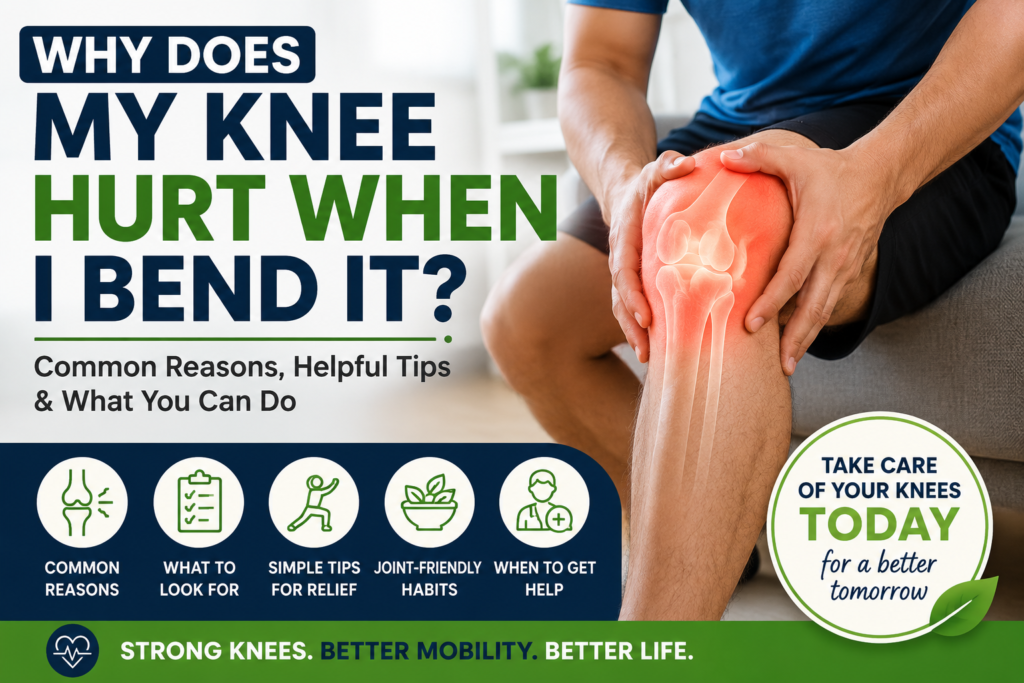
Why Does My Knee Hurt When I Bend It?

Have you ever bent down to pick something up and suddenly thought, “Wait… why does my knee hurt when I bend it?”

Maybe it is not a big pain. Maybe it happens only once in a while. Or perhaps you notice a little stiffness after sitting for a long time.

If that sounds familiar, don’t panic.

Knee discomfort can happen for many different reasons, and a little discomfort does not automatically mean that something is seriously wrong. But it can be a useful reminder to pay a little more attention to your knees and the habits that support them.

Your knees do a lot for you every day. Walking, climbing stairs, getting out of a chair, squatting, exercising—even simply standing—puts some amount of work on them.

So let’s look at some common reasons your knee may hurt when you bend it, in simple terms.

why does my knee hurt when i bend it common reasons.

Why does my knee hurt when I bend it?

There isn’t just one answer.

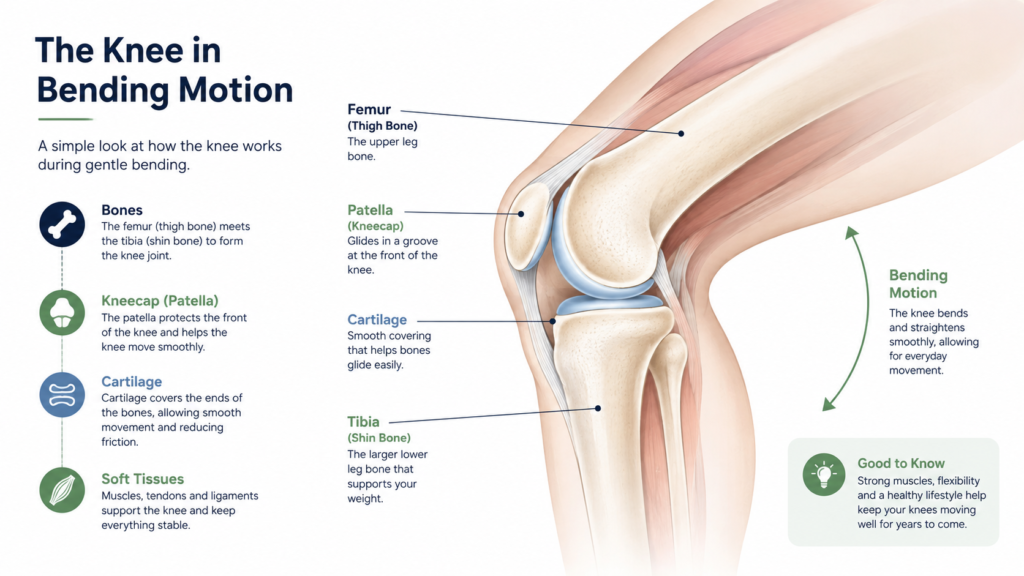
Your knee is a busy joint made up of bones, cartilage, muscles, tendons, and other tissues that all work together. When you bend your knee, these structures move and share the load.

Sometimes discomfort can simply come from doing more than your body is used to.

For example, maybe you:

  • Started exercising after being inactive
  • Walked much farther than usual
  • Spent a weekend gardening
  • Went up and down lots of stairs
  • Did many deep squats
  • Sat in one position for hours
  • Wore different shoes
  • Increased your workout too quickly

In situations like these, your knee may feel sore or stiff for a while.

That doesn’t necessarily mean you have a knee problem.

Sometimes your body is simply saying, “Hey, that was a little more work than I’m used to.”

Why does it hurt when I bend my knee?

This is one of those questions where the details matter.

Ask yourself:

When does it hurt?

Does it hurt when you first bend your knee in the morning?

Does it happen after sitting for an hour?

Does it hurt when you squat?

Does walking downstairs bother you?

Does it only happen after exercise?

Or does it hurt almost every time you bend it?

These little details can tell you more about the situation than simply knowing that your knee hurts.

It can also help to notice whether there is swelling, warmth, stiffness, clicking, catching, or a feeling that your knee is unstable.

You don’t need to become an expert on your knee.

Just start noticing patterns.

Why does my knee hurt when I bend it backwards?

If by “bend it backwards” you mean straightening your leg beyond its normal position, don’t force it.

Your knee is designed to move through a certain range. Pushing it too far can place extra stress on the tissues around the joint.

You might notice discomfort after an unusual movement, exercise, stretch, or injury.

The important thing is not to keep testing it again and again just to see whether it still hurts.

If a particular movement causes pain, back off from that movement and give your body some time.

And if the pain started after an injury, is severe, or you cannot comfortably put weight on the leg, it is a good idea to get it checked by a healthcare professional.

Why does my left knee hurt when I bend it?

If only your left knee hurts, start thinking about what may have been different recently.

Did you put more weight on that leg?

Did you twist it?

Did you start a new exercise?

Did you spend more time walking?

Did you kneel or squat more than usual?

Sometimes one side simply gets more work than the other.      left and right knee areas shown during everyday movement
You might also notice that your left knee feels different from your right knee.

That’s worth paying attention to—but it doesn’t automatically tell you what the cause is.

Instead of guessing, start keeping a simple note.

For example:

“Left knee felt uncomfortable after 30 minutes of walking.”

Then notice what happens the next time.

Patterns can be surprisingly helpful.

Why does my right knee hurt when I bend it?

The same idea applies if your right knee is the one bothering you.

Think about your recent activity.

Maybe you changed your walking routine. Maybe you spent a lot of time on your feet. Maybe you were lifting, gardening, exercising, or climbing stairs more than usual.

Even small changes in your daily routine can change how much work your knees are doing.

Again, don’t immediately assume the worst.

Instead, pay attention.

When does the discomfort appear?

What were you doing beforehand?

What seems to make it feel better or worse?

These are simple questions, but they can help you understand your own body better.

What about people who don’t have much knee pain?

This part is easy to overlook.

If your knees feel fine most of the time, that’s great.

But that doesn’t mean you should completely ignore them.

Think about your car.

You don’t wait until the engine stops working before you ever think about maintenance.

Your joints aren’t machines, of course, but the idea is similar: small healthy habits are easier to build before you really need them.

You don’t need a complicated routine.

You can start with ordinary things:

Move regularly

If you sit for long periods, get up and move around from time to time.

Keep your muscles active

Your legs and hips help support the work your knees have to do. Regular, sensible movement can help you stay strong and mobile.

Don’t suddenly go from zero to 100

If you haven’t exercised in months, you probably don’t need to start with an intense workout.

Start small.

Then gradually do more as your body gets used to it.

Pay attention to your everyday habits

Walking, sitting, sleeping, footwear, body weight, activity levels, and recovery can all be part of the bigger picture of joint wellness.

Your knee doesn’t need your attention only when it hurts

This is probably the biggest takeaway.

You don’t have to wait until you have serious knee discomfort before thinking about joint health.

A few minutes of movement.    middle-aged adult walking outdoors to support healthy joint mobility

A regular walk.

Eating a balanced diet.

Taking breaks from sitting.

Keeping track of how your body responds to activity.

Getting enough rest.

None of these things promise to prevent every knee problem. Life is not that simple.

But they are reasonable habits that can help you take better care of your overall health and mobility.

And if your knee does start bothering you, noticing the pattern early can give you something useful to talk about with a healthcare professional.

A simple question to ask yourself today

Before you move on with your day, try this:

How do my knees actually feel right now?

Not yesterday.

Not someone else’s knees.

Yours.

Do they feel comfortable?

A little stiff?

Different after sitting?

Fine during walking but uncomfortable on stairs?

You don’t need to diagnose anything.

Just notice.

Because sometimes taking better care of your body starts with something as simple as paying attention to it.


Want an easy way to start?  person recording daily joint wellness and mobility habits in a journal

If you’re interested in taking a little better care of your knees and joints—but don’t want to spend hours searching for information—we’ve put together a free Joint Wellness Starter Bundle.

It includes practical, printable resources such as a 7-Day Knee & Joint Care Checklist, Morning Mobility Routine, Joint-Friendly Food Guide, 30-Day Mobility & Habit Tracker, Knee & Joint Trigger Checklist, Back & Posture Wellness Guide, and more.

You don’t have to wait until your knees start causing problems to start building better everyday habits.

👉 Get the Free Joint Wellness Starter Bundle

This article is for general wellness education only. It is not a diagnosis or a substitute for professional medical advice. If knee pain is severe, follows an injury, keeps getting worse, or is accompanied by significant swelling, inability to bear weight, or other concerning symptoms, seek appropriate medical care.